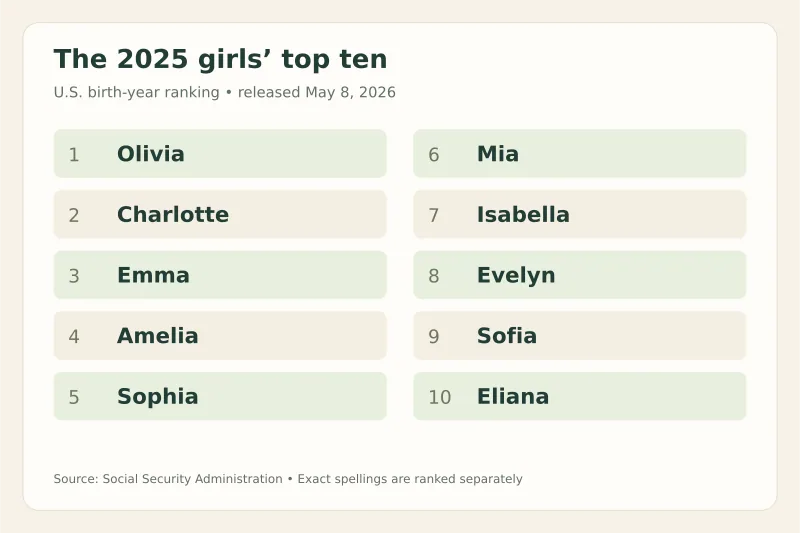
Olivia, Charlotte, Emma, Amelia, and Sophia lead SSA’s girls’ ranking for U.S. births in 2025. Start with a verified list, then build a smaller shortlist based on the sound, spelling, family significance, and everyday forms you actually enjoy.
NamesA practical guide
Baby girl names: the 2025 top ten and a thoughtful shortlist
Browse baby girl names by style, compare official popularity information, and test the names you love for pronunciation, initials, and everyday use.
Jump to a section
The quick answer
Olivia, Charlotte, Emma, Amelia, and Sophia lead SSA’s girls’ ranking for U.S. births in 2025. Start with a verified list, then build a smaller shortlist based on the sound, spelling, family significance, and everyday forms you actually enjoy.
- The displayed ranking is for births in 2025, released in 2026.
- Sophia and Sofia are separate entries in the official data.
- Name meanings need sources separate from popularity rankings.
- A shared shortlist is more useful than a huge unfiltered list.
The official top ten for girls born in 2025
The SSA release published May 8, 2026 gives this order: Olivia, Charlotte, Emma, Amelia, Sophia, Mia, Isabella, Evelyn, Sofia, and Eliana. The accompanying chart reproduces those ranks. Charlotte is second in this year’s list, and Eliana occupies tenth place. Labeling the birth year matters because an article published in 2026 can still be reporting the completed 2025 data.
Notice that Sophia and Sofia both appear. SSA treats different spellings as different entries. If your goal is an uncommon spoken name, comparing only one spelling’s rank can be misleading. If your goal is a spelling that relatives can pronounce easily, ask them to read your preferred version aloud before deciding.
A useful shortlist by shape and sound
For short written names, try Ada, Eve, Iris, June, and Mae. These offer different sounds despite similar lengths. Put each next to your surname and read it at conversational speed. Repeated vowel endings or consonants might appeal to you or feel awkward; there is no universal rule that decides it for every family.
For longer names with everyday options, compare Alexandra, Catherine, Josephine, Beatrice, and Elizabeth. Write down the shortened forms you like rather than assuming everyone will naturally choose the same one. You can prefer a formal name while remaining flexible about what the child eventually enjoys being called.
For nature-associated inspiration, consider Hazel, Ivy, Rose, Willow, and Violet. The category describes a familiar association, not a complete etymology. If you plan to tell a specific story about the origin, verify it with a reliable source rather than repeating a search snippet.
For familiar choices beyond the ten shown above, explore Clara, Lucy, Nora, Alice, and Grace. These are additional ideas, not a ranked list and not a claim that the names are rare. Look up the exact year and spelling if popularity is an important part of your decision.
Try the name at different ages without inventing a personality
You do not need to predict whether a child will be quiet, adventurous, artistic, or academic. A name is used in many contexts over a lifetime. Try a friendly introduction, a formal written name, and the shorter everyday version. Choose a name you enjoy hearing in all three settings rather than attaching a fixed personality to it.
Family connections can belong in the middle name, an initial, or a related form. Discuss the person or story being honored and whether the connection feels positive to everyone responsible for the decision. A meaningful compromise works better when the name itself is also liked.
A calm way to make the final cut
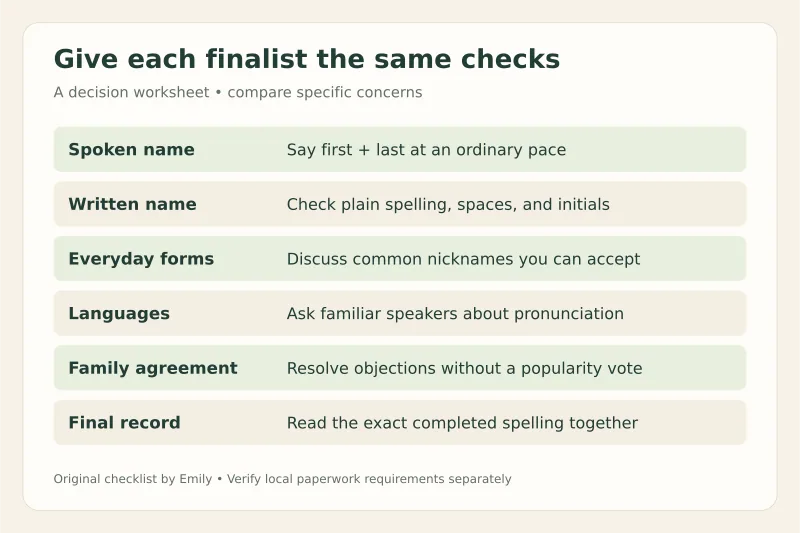
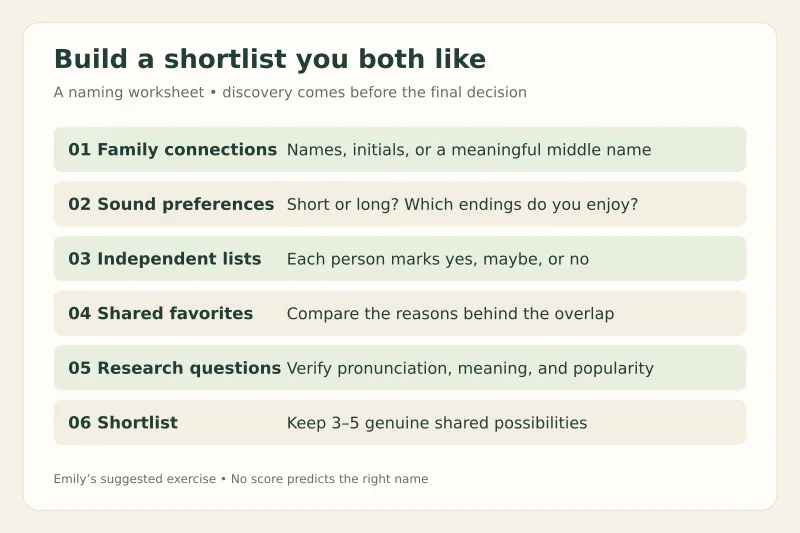
Each parent can privately select five names from the combined list, marking each as yes, maybe, or no. Compare the shared yeses first. For a maybe, name the specific concern: pronunciation, association, spelling, or a sound with the surname. That creates a question you can resolve instead of a vague argument about taste.
Keep two or three finalists for a few days and use them in ordinary conversation. If one needs repeated explanation, decide whether that is acceptable to you. A name does not have to be the most original, most popular, or most meaningful on paper to be the right shared choice.
Use popularity as one piece of context
The SSA’s official name database lets you explore U.S. names by birth year and check a name’s history. It is a better reference for popularity than an article that does not identify its year or dataset.
Decide what you actually want to know. Are you hoping for a familiar spelling, a name outside the most common group, or one that has appeared across generations? Those are different goals. A name can be recognizable without being common in your area, and a spelling change may not make its spoken form distinctive.
Test pronunciation and spelling kindly
Ask a few trusted people to read a written name without coaching. Their response gives you an idea of what explanations may be needed. It does not mean you must reject a meaningful name because someone initially mispronounces it.
If you are using a name from your heritage, correct pronunciation may be part of what makes it valuable. Discuss whether you are comfortable giving a short explanation and which spelling you prefer. For names from another language, verify pronunciation and meaning with a dependable source before making them part of your family story.
Check the whole name, including everyday versions
Try the first and last name together as well as the full name with a middle. Write the initials, possible nicknames, and a few ordinary phrases. Notice whether you enjoy both the formal version and the version likely to be used at home.
Think about sibling names if relevant, but do not require every name to follow a strict theme. Each child needs a name that works independently. Matching initials or endings can be pleasant, but they can also create confusion in conversation or on labeled belongings.
Keep the final decision manageable
Reduce your list to a few serious options. Discuss what each person likes rather than asking everyone you know to vote. Broad polling can turn a personal decision into a debate about other people’s associations.
Set a time to revisit the list, then take a break from adding new possibilities. You may want one favorite and one alternative rather than a definitive answer weeks in advance. Our baby name shortlist guide provides a simple way to move from several good names to a shared choice.
A few more details
Your questions, answered
Where can I check how common a baby girl name is?
Use the Social Security Administration’s official U.S. baby name database, selecting the year and location information relevant to your question.
Should siblings’ names match?
They do not need to. Try the names together to check clarity, but let each name work on its own rather than forcing a theme.
Why are Sophia and Sofia listed separately?
SSA counts spellings separately. Both appear in the 2025 girls’ top ten, so rank alone does not measure how often the spoken name is heard.
Are the additional names ranked by popularity?
No. They are editorial shortlists organized for comparison. Only the explicitly labeled SSA top ten is an official ranking.
Sources & product information
Follow the original sources for current product details, instructions, and guidance.