Jaundice means a baby's skin or eyes look yellow because bilirubin has built up. It is common in newborns, but a healthcare professional should assess suspected jaundice rather than a parent judging severity by color alone. Yellowing in the first 24 hours needs immediate medical attention.
CareA practical guide
Jaundice in a baby: signs, follow-up, and when to get help
Understand jaundice in a newborn, the signs that need urgent assessment, and how to prepare for bilirubin checks, feeding support, and follow-up care.
Jump to a section
The quick answer
Newborn jaundice is yellowing caused by bilirubin buildup. The baby’s age in hours, bilirubin measurement, feeding, and other risk factors determine follow-up and treatment. Contact the care team promptly if yellowing increases, feeding worsens, or the baby is hard to wake.
- Skin color alone cannot tell you the bilirubin level.
- Keep the recommended bilirubin check and follow-up appointment.
- Sunlight is not a safe replacement for prescribed phototherapy.
- Poor feeding, unusual sleepiness, or worsening jaundice need prompt advice.
Start with the urgent signs
Seek emergency care if a jaundiced baby is difficult to wake, is not feeding, has trouble breathing, becomes floppy or stiff, has unusual jerking movements, or has no wet diapers. Fever or an abnormally low temperature in a newborn is also concerning. For suspected jaundice without those signs, contact your maternity team or pediatrician promptly. These priorities follow the NHS jaundice guidance.
Dark urine or pale, chalky stools require urgent assessment. Save a diaper or take a clear photo if your clinician requests it, but do not delay the call to obtain a perfect picture.
Understand what an assessment tells you
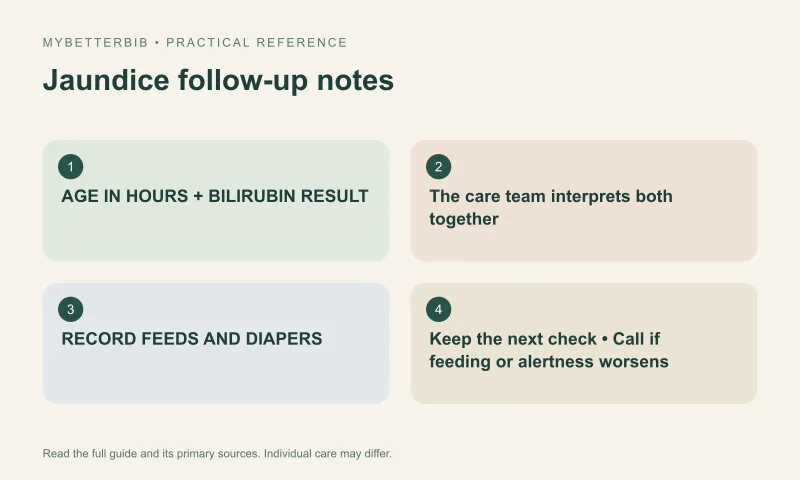
A clinician may measure bilirubin with a skin device or a blood test. The significance of a result depends on factors including the baby's age in hours and individual clinical circumstances. One number from another family's experience does not provide a treatment threshold for your baby.
At the visit, ask what the result means for your child, when the next check is due, and who will contact you. Write those answers down before leaving. If a result arrives through a patient portal without clear instructions, call for clarification instead of interpreting it alone.
Make the feeding plan specific
Tell your care team how feeds are going, whether your baby wakes for them, and whether swallowing or bottle intake seems different. Ask for feeding support if needed. Do not assume a sleepy baby is simply an easy sleeper.
A useful home record has a place for feeding times, wet diapers, stool color, and any instructions from the team. It need not be elaborate. One shared sheet or phone note is easier than several adults keeping separate, incomplete records.
Do not change feeding methods or add water as a home treatment. Decisions about additional milk, feeding frequency, or waking for feeds should follow the baby's clinical plan.
Ask for the follow-up plan before leaving the hospital
A useful discharge conversation includes whether bilirubin was measured, when it was measured, and when the baby should be examined again. Write down the appointment and contact number instead of relying on memory after a busy discharge. The result needs interpretation in the context of the baby’s age and other factors, so a single number copied from someone else’s experience cannot determine your baby’s care.
If the clinic tells you to return for a blood test, confirm the location, opening hours, and who will contact you with the result. Ask what to do if that call has not arrived by the expected time. A planned repeat measurement is part of assessing a changing condition, not necessarily a sign that an earlier assessment was wrong.
Describe feeding in a way the clinician can use
Record when the baby feeds, whether they wake and stay engaged, and the wet and dirty diapers you observe. If breastfeeding, ask for help assessing latch and milk transfer when feeds seem ineffective. If formula feeding, bring the exact product and preparation routine to the discussion. Do not dilute feeds or substitute plain water in an attempt to wash bilirubin out of the body.
The care team may recommend changes after assessing the baby, but those decisions depend on the individual situation. A support person can keep the record while the feeding parent rests. Specific observations such as “could not stay awake to finish the last two feeds” are more informative than “seems a little off.”
What phototherapy actually means for the family
Phototherapy uses a prescribed light treatment to help the body clear bilirubin. The clinical team determines whether it is needed and how the response is checked. Ask how feeding, diaper changes, eye protection, temperature, and repeat testing will be handled. If home equipment is prescribed, get the setup demonstrated and confirm who provides support if the device stops working.
An ordinary lamp or sitting beside a window does not reproduce that monitored treatment. The AAP’s newborn jaundice guidance explains why bilirubin testing and medical follow-up matter. Do not postpone an advised assessment to experiment with sunlight, supplements, or another family’s home remedy.
Watch the baby as well as the yellow color
Yellowing can be harder to recognize in some skin tones and lighting conditions. Ask the clinician to show you what to look for, including the whites of the eyes, while remembering that visual inspection cannot replace a measurement. Mention unusually pale stools or dark urine promptly. If the baby is difficult to awaken, has breathing trouble, has a seizure, or looks seriously unwell, seek emergency care.
For a non-emergency call, have the baby’s date and time of birth, the last bilirubin result if available, feeding pattern, diaper record, and discharge instructions nearby. You do not need every detail before calling. The key action is to obtain timely advice when the pattern changes or the planned follow-up has not been arranged.
A few more details
Your questions, answered
Can I tell how serious jaundice is by looking at my baby?
No. Appearance alone cannot establish bilirubin level or treatment needs. A clinician may use a skin measurement or blood test.
Does sunlight replace phototherapy?
No. Medical phototherapy uses specific equipment and monitoring. Do not substitute sunlight or a household lamp for prescribed treatment.
What should I bring to a jaundice follow-up visit?
Bring the discharge instructions, any bilirubin result, the baby’s date and time of birth, and observations about feeds and wet or dirty diapers. Do not delay an urgent call to complete the record.
Does a baby with jaundice need water between feeds?
Do not give water to treat jaundice. Follow the care team’s feeding and treatment plan and ask for help if feeds are not going well.
Sources & product information
Follow the original sources for current product details, instructions, and guidance.