Choose a resale route by item type and effort: a local buy-outright store for convenience, a marketplace for more control, or consignment under clear terms. Check recalls and condition first. As checked September 30, 2026, GoodBuy Gear’s official seller page says it is not accepting resale items.
RegistryA practical guide
Where to sell baby items: compare local stores and online options
Compare local resale stores, online listings, and consignment for baby items. Learn how to check recalls, describe condition, and calculate a sensible sale.
Jump to a section
The quick answer
Choose a resale route by item type and effort: a local buy-outright store for convenience, a marketplace for more control, or consignment under clear terms. Check recalls and condition first. As checked September 30, 2026, GoodBuy Gear’s official seller page says it is not accepting resale items.
- Check recalls, condition, parts, and identifying labels first.
- Compare the expected net payment after fees and effort.
- GoodBuy Gear’s seller intake is currently paused on its official page.
- Photograph the actual used item, including wear and labels.
At a glance
The details that make a difference when you’re deciding.
| Route | Main benefit | Work or limitation |
|---|---|---|
| Buy-outright store | One local offer | Acceptance and price vary by store |
| Online marketplace | Control over listing | Photos, messages, fees, shipping |
| Consignment | Shop or event handles sale | Commission and unsold-item deadlines |
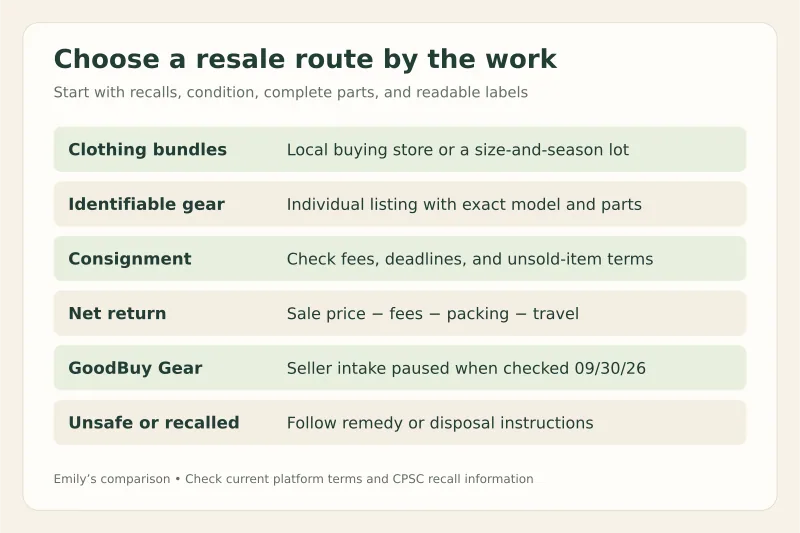
| GoodBuy Gear | Check official seller information | Intake paused when checked September 30, 2026 |
Current selling options, with an important update
Once Upon a Child: local stores buy selected children’s clothing, shoes, toys, and equipment under their own acceptance process. Use the official location information and call before bringing a large load. Buying preferences and capacity can vary. A store offer trades some potential selling price for reduced work; it is reasonable to compare that with the time required to list individual low-value pieces.
eBay: a marketplace can make sense for an identifiable item with buyers beyond your local area. Inspect current seller fees, shipping costs, and category rules. Search completed or sold listings for a better indication of actual transactions; an ambitious asking price on an unsold listing does not show what a buyer will pay.
Local consignment: an event or shop may suit seasonal clothing and bundles, but ask about the commission, tagging work, payment timing, and the deadline for retrieving unsold items. Read what happens to anything left behind. The process is different from receiving a buy-outright offer at a store.
GoodBuy Gear: its official seller page currently says it is not accepting items for resale. Its mail-in information likewise says mail-in intake is not available. This was checked September 30, 2026. Older articles describing pickup or mail-in services should not be treated as a current invitation to send goods.
A worked example of the decision
Suppose you have twelve ordinary bodysuits and one identifiable stroller. Photographing, describing, packing, and shipping every bodysuit separately may take much more effort than selling a clean size-and-season bundle or accepting a local offer. The stroller may justify a separate listing because model, condition, accessories, and local collection affect its value more directly.
Estimate the net return for each route: expected sale price minus platform fees, shipping you cover, packaging, and travel. Keep a separate line for time. If a higher advertised selling price disappears after costs and several hours of work, the apparently lower local offer may be a sensible choice.
The photographs a buyer actually needs
Show the complete item, a clear label, included parts, and close-ups of wear. Photograph stains in normal light rather than hiding them with a filter. For a clothing bundle, list the number of garments, sizes, sleeve lengths, fabric information from the labels, and any known defects. Manufacturer photographs are not a substitute for showing the condition of your used item.
For connected equipment, remove personal information using the manufacturer’s reset directions and confirm what still works. Keep the exact model and serial or date information available for the safety check, sharing only what is appropriate for the transaction. Missing labels can make a piece harder to verify even when it looks intact.
Decide what should not be passed on
Use the CPSC recall database and reseller guidance before offering baby equipment. A working latch or clean fabric does not establish safety. Do not sell or donate a recalled or unsafe item as if another family can simply use it carefully; follow the recall remedy or disposal instructions instead.
For items such as car seats, where history and manufacturer requirements matter, do not invent a safety assurance to make a sale. Check whether the chosen platform or store accepts the category at all. A clear refusal to sell an unsuitable item is part of responsible resale, not a reason to move it to a less visible marketplace.
Compare a local buying store with consignment
A buying store evaluates items and makes an offer. Once Upon a Child describes this process and notes categories it will not buy, including car seats and recalled items. Check the local store’s instructions and needs before loading the car.
Consignment usually means a shop or event sells on your behalf under its own agreement. Before committing, ask about the seller share, fees, payment timing, unsold items, and pickup deadlines. Do not assume every event or shop follows the same terms.
Use online listings when the extra work makes sense
An online marketplace can work well for items with a clear model or clothing sold in useful size-and-season bundles. You will need photos, a description, buyer communication, packing, and a plan for delivery or collection.
For example, eBay’s selling guidance explains its platform, while its current fee information helps you evaluate costs. Read the terms that apply to your account and listing. Avoid pricing from an old blog post about fees or a screenshot of someone else’s payout.
Write a listing that answers real questions
Photograph the actual item in clear light. Show labels, included components, and any wear. A useful clothing description might say: “Six 3–6 month cotton bodysuits; washed; two have small visible marks shown in the final photos.”
For equipment, include the model and relevant date information from the label, confirm which parts are included, and provide the manufacturer’s instructions when available. Do not describe a used item as certified or safety-tested unless you have specific evidence supporting that claim. Honest details reduce disputes and wasted messages.
Calculate the return on your time
Estimate the sale price minus platform charges, packaging, shipping you cover, and travel. Then consider the time required. A modest local offer may be sensible if individually listing many low-value items would consume several evenings.
Use the platform’s recommended payment and collection process. Remove personal information from any connected product before transfer, following the manufacturer’s reset instructions. If an item is unsuitable for sale, follow recall remedies or local disposal guidance rather than donating a hazard. Keep a brief sale record until payment and delivery are resolved.
A few more details
Your questions, answered
Is a resale store or online listing better for baby clothes?
A store can save time, while an online listing gives you more control over bundles and pricing. Compare likely proceeds after fees, shipping, and your time.
Can I donate an item that is not safe to sell?
Do not pass on a recalled, damaged, or unsafe item simply because it is free. Follow the recall remedy or appropriate local disposal instructions.
Is GoodBuy Gear accepting items from individual sellers right now?
Its official seller and mail-in pages said intake was unavailable when checked September 30, 2026. Recheck those pages before planning a sale; older service descriptions may be outdated.
Should I use manufacturer images in my used-item listing?
Photograph the actual item and its wear, labels, and included parts. A stock product image does not show the condition a buyer will receive.
Sources & product information
Follow the original sources for current product details, instructions, and guidance.